What an NVR does
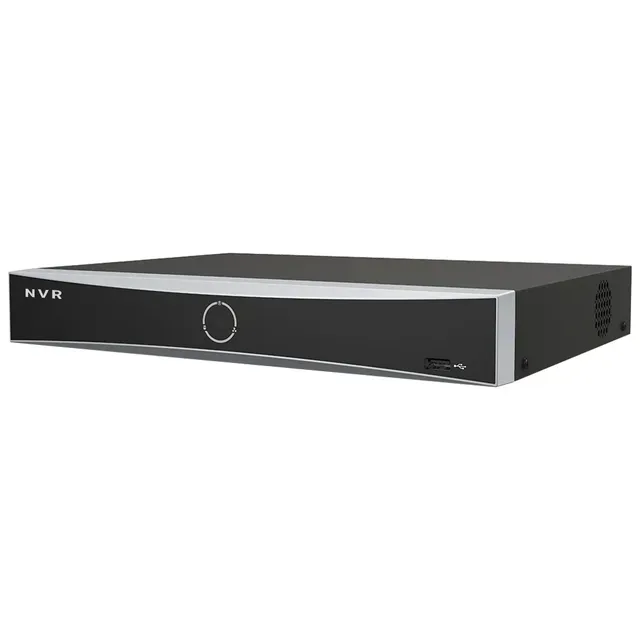
A network video recorder (NVR) records IP cameras. Each camera compresses its own video and sends it over Ethernet, so the NVR mainly stores, plays back and manages the streams. Because the processing happens in the camera, an NVR can record very high resolutions.
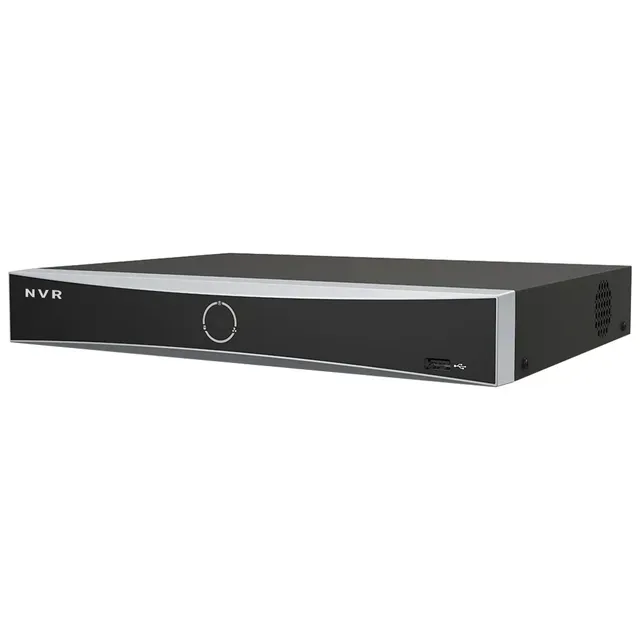
Our two NVRs have built-in PoE ports, so you plug each camera straight into the back of the recorder with a single network cable for power and video. The NVR1204-4 has 4 PoE ports for 4 IP cameras. The NVR1208-8P has 8 PoE ports for 8 IP cameras. Both record up to 12MP and have a 4K HDMI output.
What a DVR and a hybrid DVR do
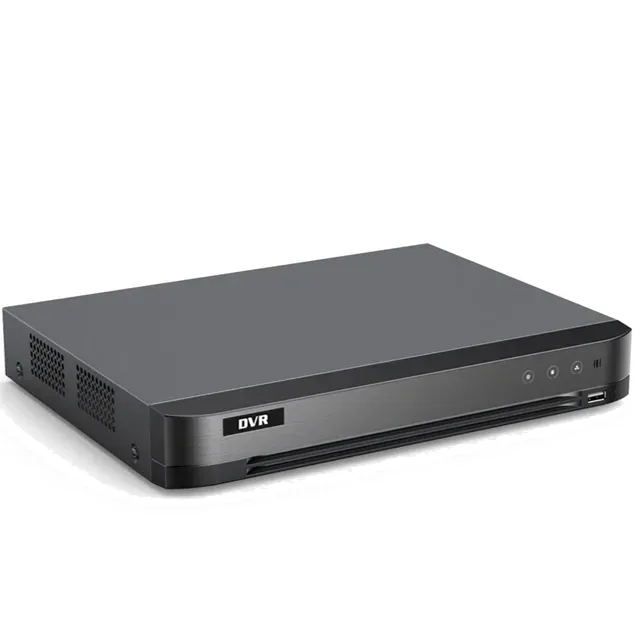
A digital video recorder (DVR) records analogue cameras connected by coax. The camera sends an HD analogue signal and the DVR converts it to digital, compresses it and records it.
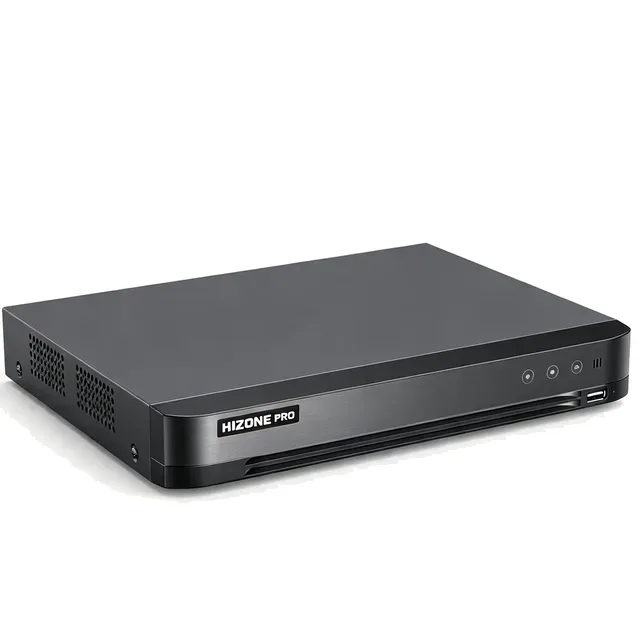
All six DVRs we supply are AcuSense hybrid models. Each analogue input automatically detects HD-TVI, AHD, CVI and CVBS signals, and the recorders also accept IP cameras over the network. This makes a hybrid DVR a good fit for upgrades, where you keep the coax runs that work and add IP cameras on new cable.
Our recorders side by side
The table lists the real channel counts from the specifications. On the hybrid DVRs the IP figure is shown as a standard number and a maximum. The maximum is reached by switching analogue channels over to IP in the recorder settings.
- The 3K hybrid DVRs encode analogue cameras up to 3K/5MP Lite and suit our 3K and 5MP TVI cameras.
- The 4K hybrid DVRs encode analogue cameras up to 8MP, so they suit our 4K T289 TVI cameras.
- The DVR-804XT encodes 8MP at 8 fps on one channel and 5MP at 12 fps, so check frame rates if you plan several 4K analogue cameras on it.
| Model | Type | Analogue inputs | IP camera inputs | Max IP camera resolution |
|---|---|---|---|---|
| NVR1204-4 | NVR, 4 PoE ports | None | 4 | 12MP |
| NVR1208-8P | NVR, 8 PoE ports | None | 8 | 12MP |
| DVR-504XT | 3K hybrid DVR | 4 | Up to 6 | 6MP |
| DVR-508XT | 3K hybrid DVR | 8 | Up to 12 | 6MP |
| DVR-516XT | 3K hybrid DVR | 16 | 8 (up to 24) | 6MP |
| DVR-804XT | 4K hybrid DVR | 4 | 4 (up to 8) | 8MP |
| DVR-808XT | 4K hybrid DVR | 8 | 8 (up to 16) | 8MP |
| DVR-816XT | 4K hybrid DVR | 16 | 16 (up to 32) | 8MP |
Cabling and power
An NVR system uses CAT5e or CAT6 network cable. Each run can be up to 100 metres from the PoE port to the camera. If you need more cameras than the recorder has PoE ports, or a camera sits further away, add a PoE switch. Our HA-POES806 and HA-POES810 switches provide 4 and 8 PoE ports at up to 30 W each.
A DVR system uses coax with BNC connectors and a 12V DC feed to each camera. Our HD BNC and DC cables carry video and power in one lead. A central 12V power box with individually protected outputs is the neatest way to power several cameras. Where the route suits network cable better, passive baluns carry TVI video over CAT5e or CAT6.
Which recorder should you choose
If you are replacing an old DVR, match or exceed its channel count so every existing cable has an input. Our channel sizing guide covers this in more detail.
- Choose an NVR for a new installation with network cable, or if you want 12MP cameras such as the IPT2120.
- Choose a 3K hybrid DVR when you are upgrading existing coax with 3K or 5MP TVI cameras and want IP inputs available for later.
- Choose a 4K hybrid DVR when you want 4K TVI cameras on coax, or 8MP IP cameras alongside analogue ones.
- Choose the 16-channel hybrid models when a site has many existing coax runs and you want spare inputs for growth.
Smart features on both
Both families include detection that cuts false alerts from moving trees, rain and headlights. The NVRs use IntelSense and support camera-based features such as perimeter protection and motion detection 2.0. The hybrid DVRs use AcuSense deep learning with human and vehicle analysis on a set number of channels, and AcuSearch or IntelSearch to find events quickly in playback.
The number of analysed channels varies by model. For example, the DVR-808XT supports 8-ch advanced perimeter protection or 4-ch facial recognition, while the DVR-504XT supports 2-ch perimeter protection or 1-ch facial recognition.
Compatibility with Hikvision and HiLook
HiZone Pro recorders run on the Hikvision platform. Hikvision cameras work on HiZone Pro recorders, and HiZone Pro cameras work on Hikvision and HiLook recorders. If you already own Hikvision or HiLook cameras, you can move them onto a new HiZone Pro NVR or hybrid DVR.
Build your system
Browse our NVRs and hybrid DVRs, or use the camera planner to put a recorder, cameras, cable and power into one basket. Trade customers can request pricing for multiple systems through the trade page.
We supply equipment only. If you would like the system fitted, we can introduce you to one of our recommended installers.