Decide what each camera needs to capture
Before choosing a position, decide what each camera is for. One camera rarely does everything well. A wide view of the whole driveway shows what happened. A closer view of the front door or the gap people walk through shows who did it.
Most homes are well covered with two or three cameras. One covers the driveway and cars, one covers the front door and porch, and one covers a side gate or path to the back garden.
- Overview. The whole driveway and any parked cars.
- Identification. Faces at the front door or at the point where people enter the property.
- Access points. Side gates, bin stores and passages to the rear.
Mounting height and angle
A height of roughly 2.5 to 3 m works well for most driveway cameras. It is high enough to be hard to reach or knock out of position, and low enough to see faces. Mount much higher and you get a good view of the tops of heads and very little of the face.
Tilt the camera down so the bottom of the image starts a short distance in front of the wall and the far edge of your driveway sits well inside the frame. Avoid pointing straight into the sky, as bright sky darkens faces. Under a soffit or porch roof, the camera is protected from rain and from direct sun at sunrise and sunset.
Field of view and placement
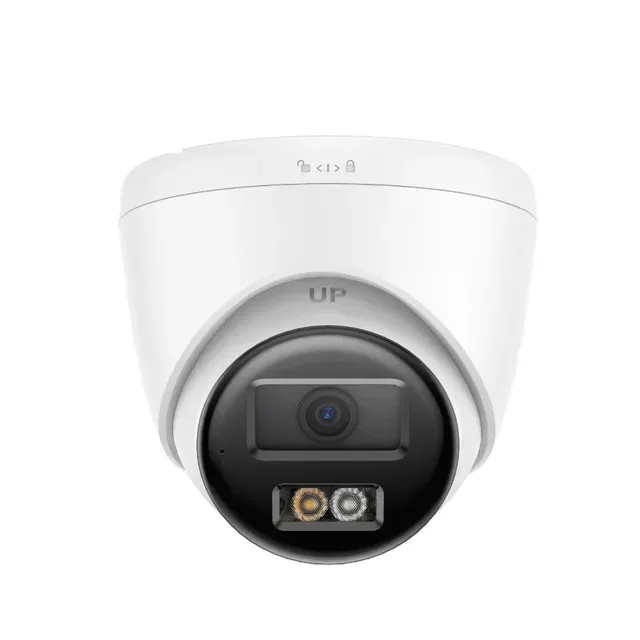
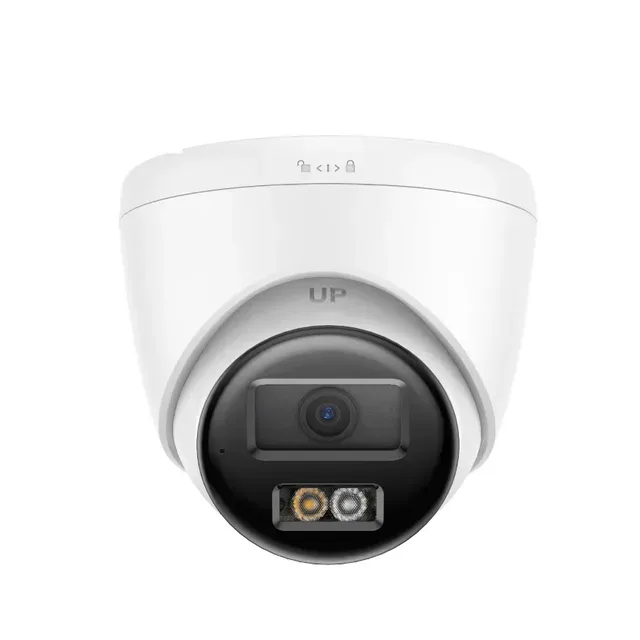
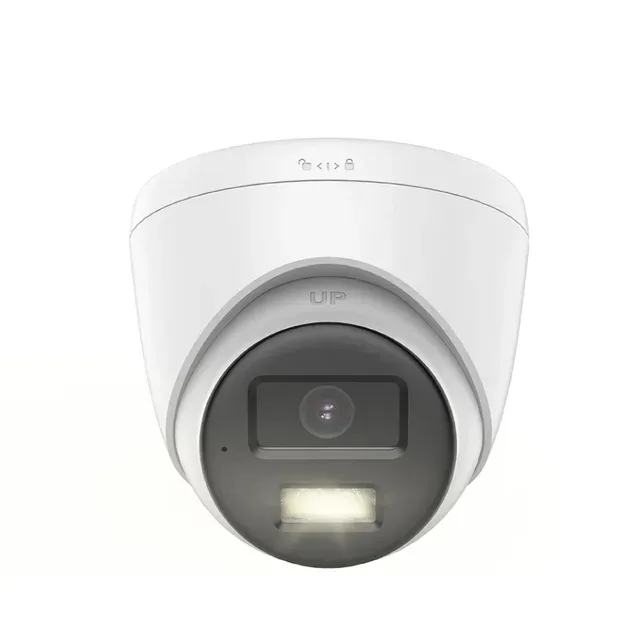
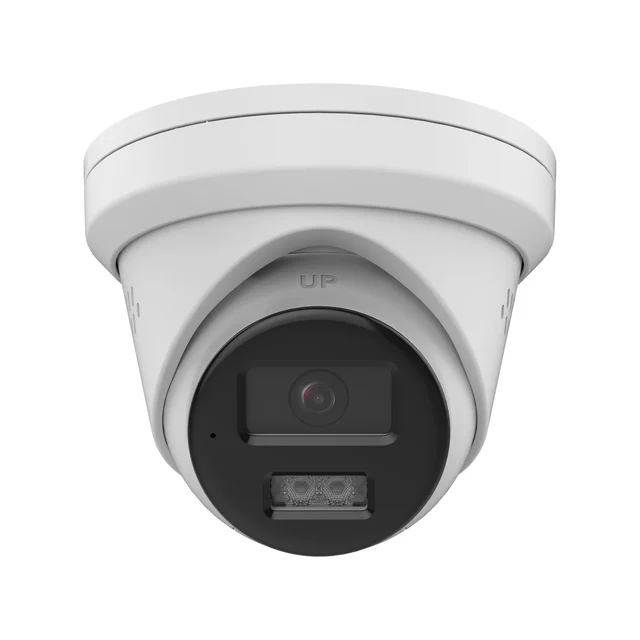
All of our turret cameras use a 2.8 mm fixed lens, which gives a wide view suited to driveways and gardens. A wide lens covers a lot of ground, but detail falls off with distance. Use these cameras for overview and place them where people pass within a few metres if you want clear faces.
- Mount a camera on the corner of the house to look along the driveway towards the road, so cars are seen as they arrive.
- Mount a second camera near the door looking out, so visitors are caught face-on as they approach.
- Higher resolution helps when you zoom into a recording. The 8MP 4K and 12MP models give the most detail across a wide scene.
- Number plates need a close, narrow view. A wide 2.8 mm lens will show the car clearly near the house but is not designed to read plates at the road.
| Camera | Resolution | Horizontal view | Vertical view |
|---|---|---|---|
| IPT250W-HT / IPT250B-HT | 5MP 3K (3072 × 1728) | 98° | 54° |
| IPT280W-HT / IPT280B-HT | 8MP 4K (3840 × 2160) | 105° | 55° |
| T289W-HT / T289B-HT | 8MP 4K (3840 × 2160) | 105° | 62° |
Lighting and colour night vision
Most incidents on driveways happen after dark, so night performance matters as much as daytime resolution. Infrared gives a black and white picture with no visible light. White light gives a full colour picture, which makes it far easier to describe a car, a coat or a bag.
Our smart hybrid light cameras switch between the two. They can stay in discreet infrared and turn on white light when they detect activity, giving you colour footage of the moment that matters. The T289 and T259 HT ColorVu TVI cameras reach up to 40 m with white light and 40 m with infrared. The IPT250, IPT280 and IPT2120 IP cameras reach up to 30 m.
Think about neighbours when you use white light. A bright light that stays on all night can shine into bedrooms across the road. Smart mode, which lights up only on activity, keeps the light where and when you need it.
Privacy, neighbours and the law
Aim cameras at your own property. If a camera captures images beyond your boundary, such as the pavement, the road or a neighbour's garden or windows, UK data protection law applies to you and you take on responsibilities as the person in control of the footage.
In practice that means having a clear reason for the coverage, keeping it to what you need, storing footage securely, deleting it when you no longer need it and handling requests from people who ask for footage of themselves. Adjust camera angles to cut out neighbouring property, and use privacy masking where your system supports it. Recording audio is more intrusive still and best left switched off. The ICO publishes clear guidance for domestic CCTV users, and it is worth reading before you install.
Talking to your neighbours before you fit cameras avoids most disputes. Show them what the camera sees if they ask.
Which of our cameras suit a driveway
Human and vehicle detection on the IPT250 and IPT280 helps cut alerts from swaying trees, passing headlights and cats. All of these cameras are rated IP67 for dust and water resistance.
| Camera | System | Why it suits a driveway |
|---|---|---|
| IPT280W-HT / IPT280B-HT | IP | 8MP 4K detail, human and vehicle detection, smart hybrid light up to 30 m, two-way audio |
| IPT250W-HT / IPT250B-HT | IP | 5MP 3K, human and vehicle detection, audible warnings, smart hybrid light up to 30 m |
| IPT2120W-HT / IPT2120B-HT | IP | 12MP (4096 × 3072) for the most detail when zooming into recordings |
| T289W-HT / T289B-HT | TVI | 4K ColorVu with white light and IR up to 40 m, two-way audio over coax |
| T259W-HT / T259B-HT | TVI | 5MP ColorVu with white light and IR up to 40 m, ideal for upgrading existing coax |
Recorders and wiring
For a new installation, IP cameras on a PoE NVR are the tidiest option, with one network cable per camera. The NVR1204-4 takes four cameras and the NVR1208-8P takes eight. If your house already has coax cable from an older system, TVI cameras on one of our AcuSense hybrid DVRs let you reuse it. Use a deep base or junction box at each camera to keep cable joints dry. HiZone Pro cameras also work on Hikvision and HiLook recorders if you are adding to an existing system.
Build your driveway system
Use the camera planner to choose cameras, a recorder and cable, then send your order. We supply the equipment and can put you in touch with an installer from our recommended panel if you would like it fitted.